 Chloe HartLast Modified: Sep 23, 2026
Customer Feedback System for SaaS: Turn Feedback Into Insights




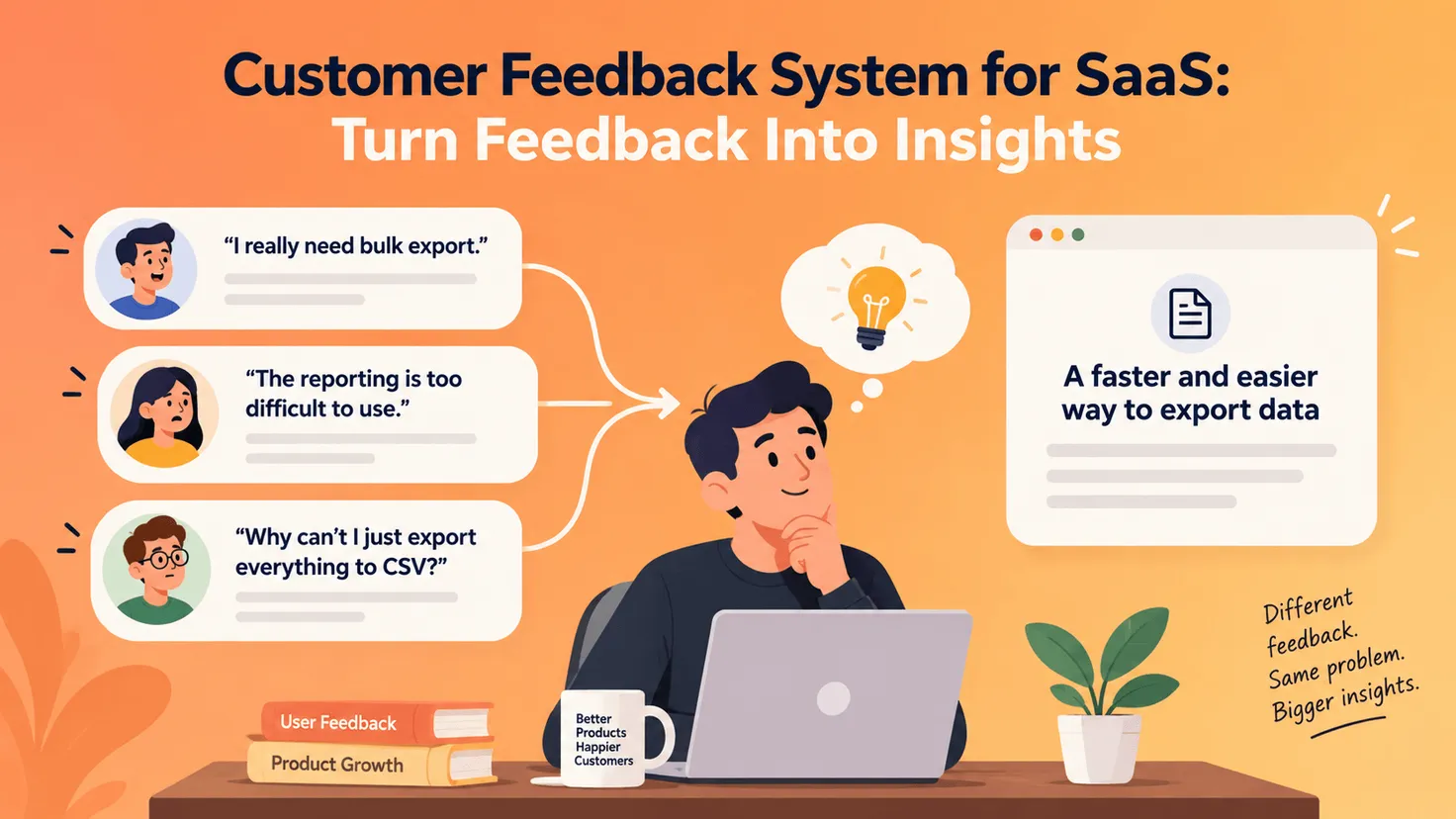
A customer tells you, “I really need bulk export.”
Another says, “The reporting is too difficult to use.”
A third asks, “Why can't I just export everything to CSV?”
At first glance, these look like three different pieces of customer feedback. A product team might create three tickets, tag them separately, and add all three to the backlog. But after talking to these customers, the team may discover that they are actually struggling with the same underlying problem: they need a faster way to get data out of the product and use it somewhere else.
This is one of the reasons customer feedback becomes difficult to manage as a product grows. Customers are usually good at describing what they want in the moment, but what they ask for is not always the same as the problem they are trying to solve. “Add an export button” sounds like a clear feature request until you discover that one customer needs it for a weekly report, another wants to move data into another system, and a third simply needs to share information with a colleague.
The challenge becomes even harder because feedback rarely arrives in one place. It appears in support conversations, emails, surveys, interviews, public feedback boards, social media, community discussions, and conversations inside the product. A company can collect thousands of messages and still struggle to answer a surprisingly basic question: What are our customers actually trying to tell us?
That is the problem a customer feedback system is supposed to solve.
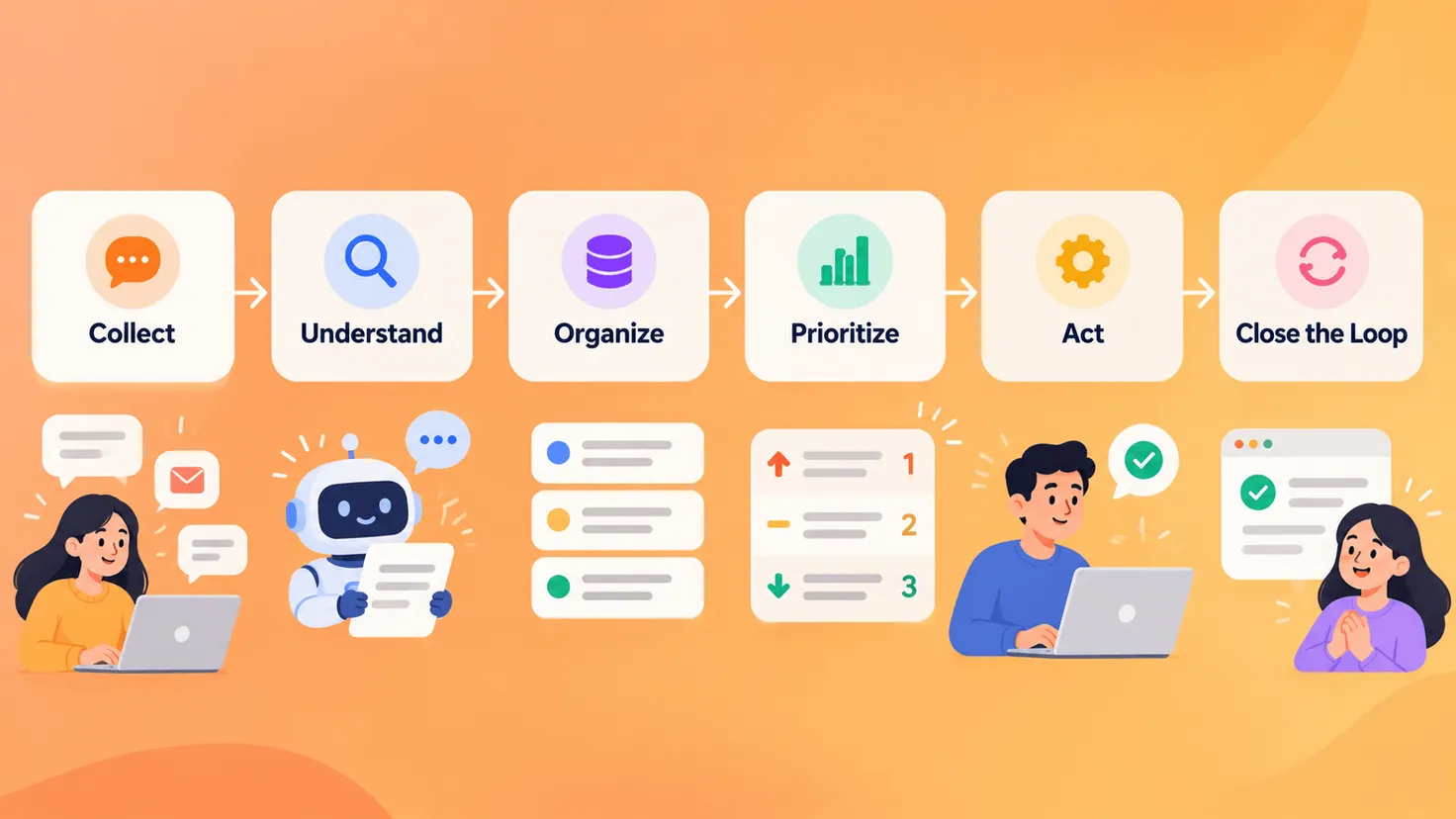
A useful system does more than collect messages. It creates a process for turning those messages into information that a product team can understand and act on. In practice, that process can be described as:
Collect → Understand → Organize → Prioritize → Act → Close the Loop
For years, feedback software has been particularly good at the first and third parts of this process: collecting feedback and organizing it. AI introduces an interesting possibility in between. Instead of waiting until after submission for a product manager to interpret what a customer meant, the system can begin clarifying the problem while the customer is still describing it.
This guide looks at how a modern customer feedback system works, where traditional feedback methods tend to break down, and how AI can improve the quality of feedback without taking product decisions away from the people responsible for making them.
What Is a Customer Feedback System?
A customer feedback system is a structured process for collecting, understanding, organizing, prioritizing, and acting on customer feedback. The important word here is “system,” because collecting feedback is only one part of the job.
A feedback form, for example, can make it easy for users to submit an idea.
A survey can measure satisfaction across hundreds of customers.
A public board can let people submit feature requests and vote on existing ones. Each of these tools solves a useful problem, but none of them necessarily tells a product team how raw customer messages should become product decisions.
Consider a SaaS company that receives the request, “Please add Slack integration.” If that sentence is simply stored in a backlog, the team knows what one customer asked for but very little else. Once the request becomes part of a broader feedback process, however, the picture may change. The team might discover that 15 other customers have made similar requests, that most of them are actually asking for notifications rather than a full Slack integration, and that the requests primarily come from teams that need to monitor important events without keeping the product open all day.
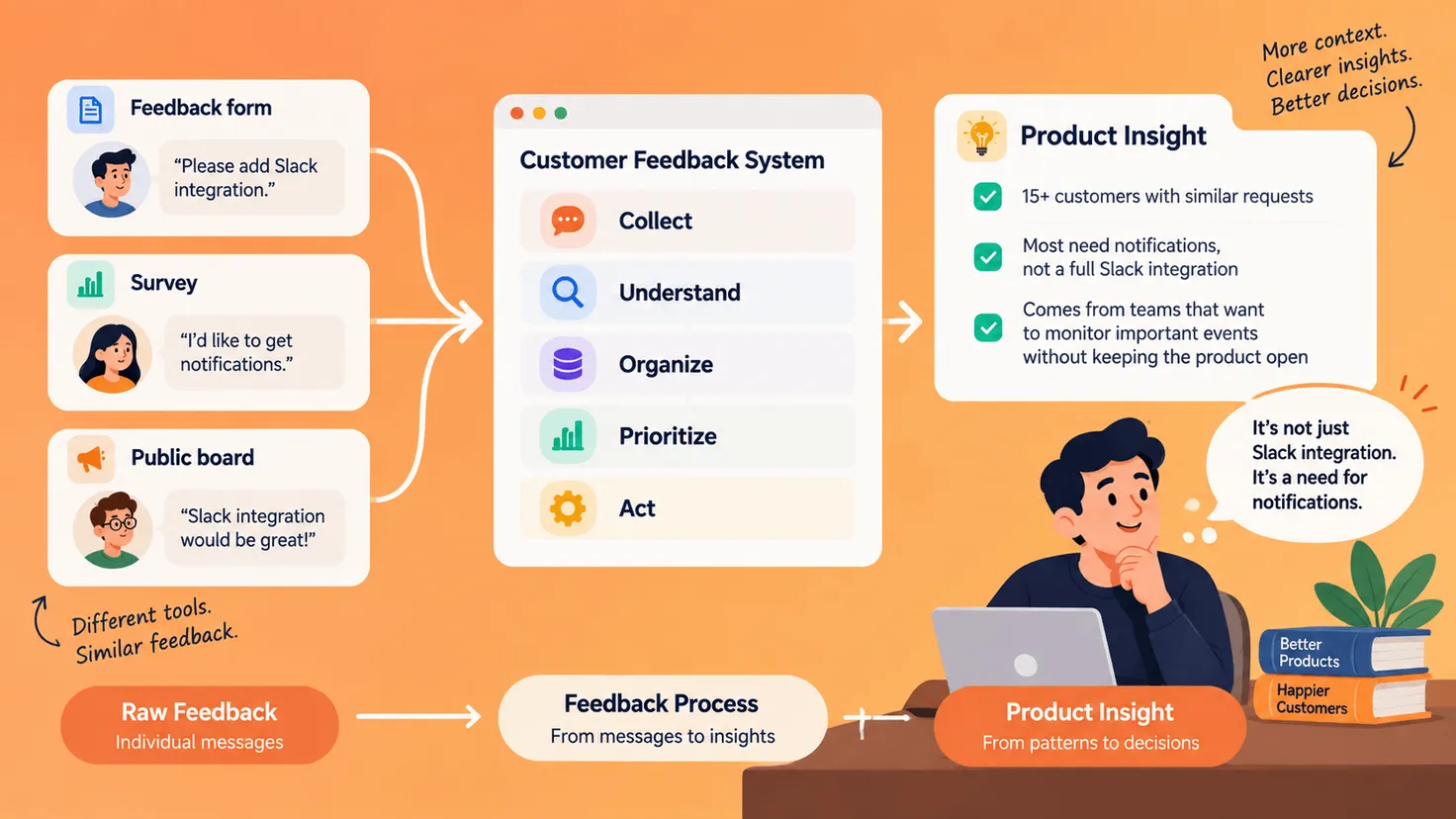
The original feedback has not changed, but the team's understanding of it has. What looked like a request for a specific integration may actually point to a broader problem around notifications and workflow.
That transformation is the real purpose of a customer feedback system. The goal is not to create the largest possible database of requests. It is to move from raw feedback to context, from context to patterns, and from patterns to useful product insight.
The Six Layers of a Modern Customer Feedback System
It is tempting to think of feedback management as a simple pipeline: collect a request, put it in a backlog, and decide whether to build it. In reality, several different kinds of work happen between the moment a customer speaks and the moment a product decision is made.
A practical customer feedback system can be understood as six connected layers:
Collect → Understand → Organize → Prioritize → Act → Close the Loop
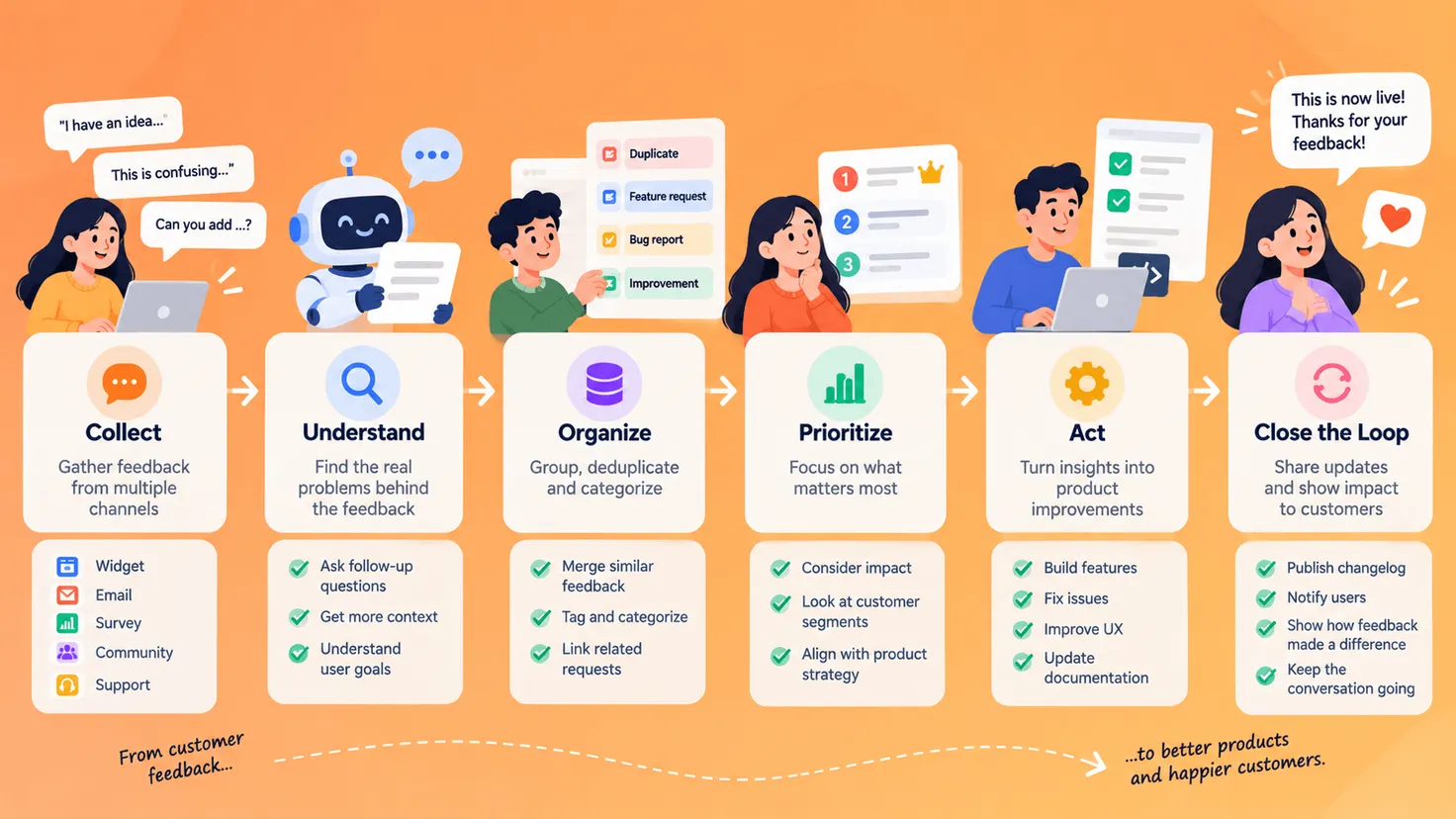
The first layer, Collect, is about making it easy for customers to communicate.
Feedback might come through an in-product widget, a survey, support email, interview, community, sales conversation, or public feedback board. These channels are not interchangeable. A survey is useful when you want structured responses from a large group, while an interview is better when you need to understand why someone behaves in a particular way. An in-product feedback widget captures another kind of signal because the customer can describe the problem while they are actually experiencing it.
The second layer, Understand, is less visible but often more difficult.
Suppose someone writes, “The dashboard needs more customization.” The sentence sounds actionable, but the product team still doesn't know what the customer is trying to accomplish. They might want a different layout, additional filters, custom reports, or more widgets. They might not need “customization” at all; perhaps the real problem is that the information they use most often is difficult to find.
Once the meaning is clearer, the feedback needs to be Organized.
Similar requests can be grouped, duplicates identified, and feedback connected to product areas, customer segments, sources, or statuses. This is what allows a team to stop looking at hundreds of isolated sentences and start seeing recurring patterns.
Only then does Prioritization become useful.
The number of requests matters, but it is rarely enough on its own. A feature with 100 votes may be less important than a problem affecting 20 customers if those 20 customers encounter the issue every day or if the problem prevents them from completing a core workflow. Revenue impact, strategic relevance, severity, customer segment, and development effort may all matter alongside frequency.
The final two layers are Act and Close the Loop.
Some feedback becomes a feature, some leads to a bug fix or documentation change, and some results in a decision to do nothing. When work does ship, customers should be able to see what happened through a roadmap, changelog, product update, or direct notification.
Thinking about feedback in these six layers helps explain an important limitation of many traditional workflows. Teams have become increasingly good at collecting more customer feedback and storing it more efficiently, but collecting more information does not automatically mean understanding customers better.
Why Customer Feedback Becomes Harder as a Company Grows
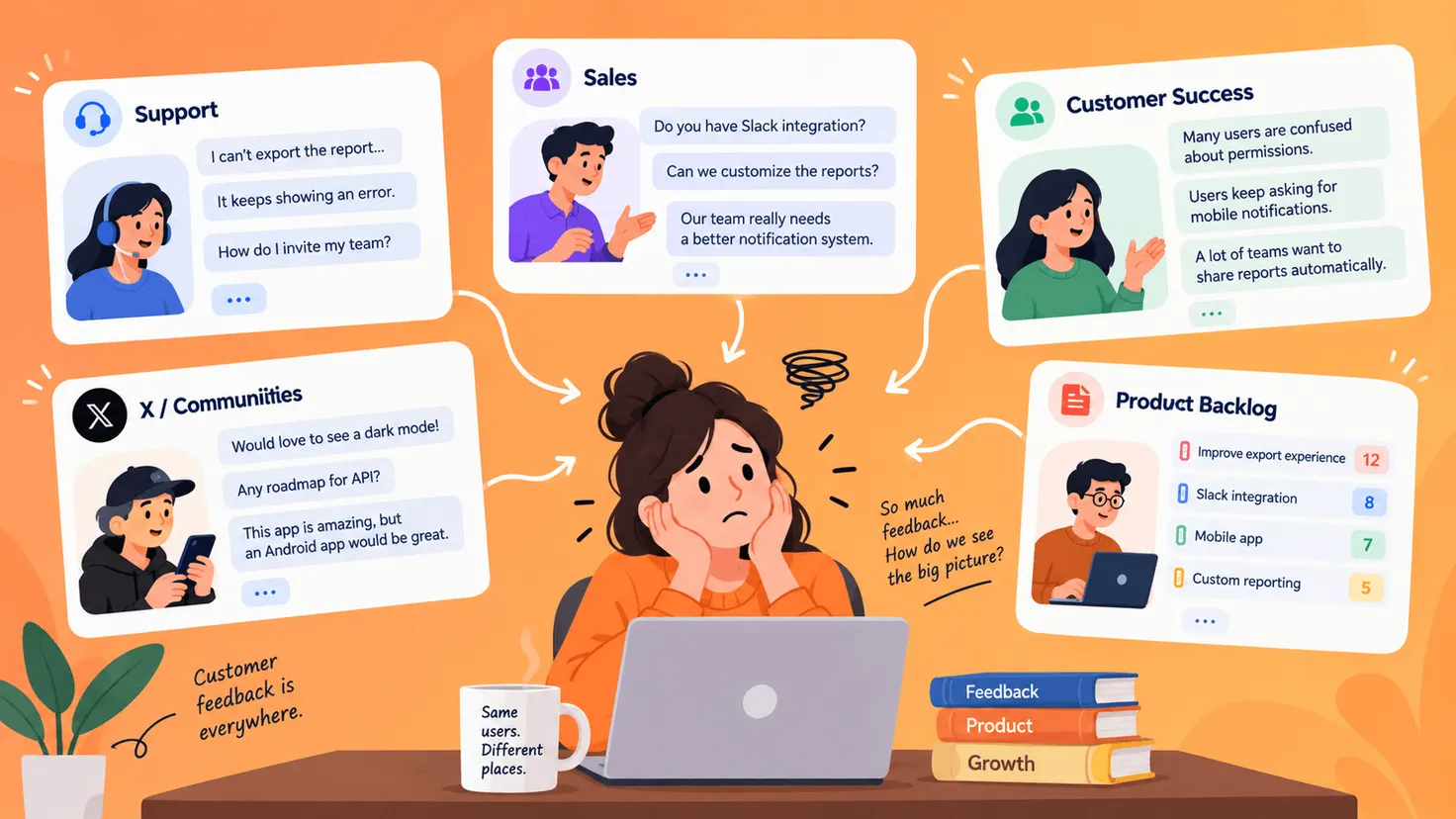
Most growing SaaS companies do not suffer from a lack of feedback. In fact, growth often creates the opposite problem: customer information begins to appear everywhere.
Support sees complaints and troubleshooting questions. Sales hears objections and missing-feature requests during demos. Customer success learns about recurring workflow problems during calls. Founders may receive suggestions directly on X or in communities, while the product team maintains a separate backlog of requests that have already been identified as product feedback.
Each team sees a valid part of the customer experience, but those signals rarely arrive in the same place or in the same format. This means that simply asking customers for more feedback can make the problem worse. The company creates more information without necessarily creating more understanding.
One common issue is that valuable product feedback is hidden inside conversations that were never intended to be feedback submissions. Imagine a customer contacting support with the following message:
“How can I export my monthly report? I also wish I could schedule this automatically because I have to do it every Monday.”
The first sentence is clearly a support question. The second contains a product request. But the most useful information may actually be the final phrase: the customer repeats this task every Monday. That context tells the product team something about frequency and workflow that a simple “add scheduled reports” feature request would not capture.
Another problem is that the same need can appear in very different language. “Add Slack alerts,” “Send notifications to Slack,” and “Can my team receive product updates in Slack?” may look like separate requests when viewed individually. Read together, they may point to one recurring problem: customers want important product information to reach the communication environment where their team already works.
A customer feedback system therefore needs to do more than centralize messages. Centralization solves the problem of where feedback is stored. It does not automatically solve the harder problem of what that feedback means.
Traditional Customer Feedback Methods Still Matter
AI does not make traditional feedback methods obsolete. Forms, surveys, interviews, support conversations, and public feedback boards remain useful because they capture different kinds of information.
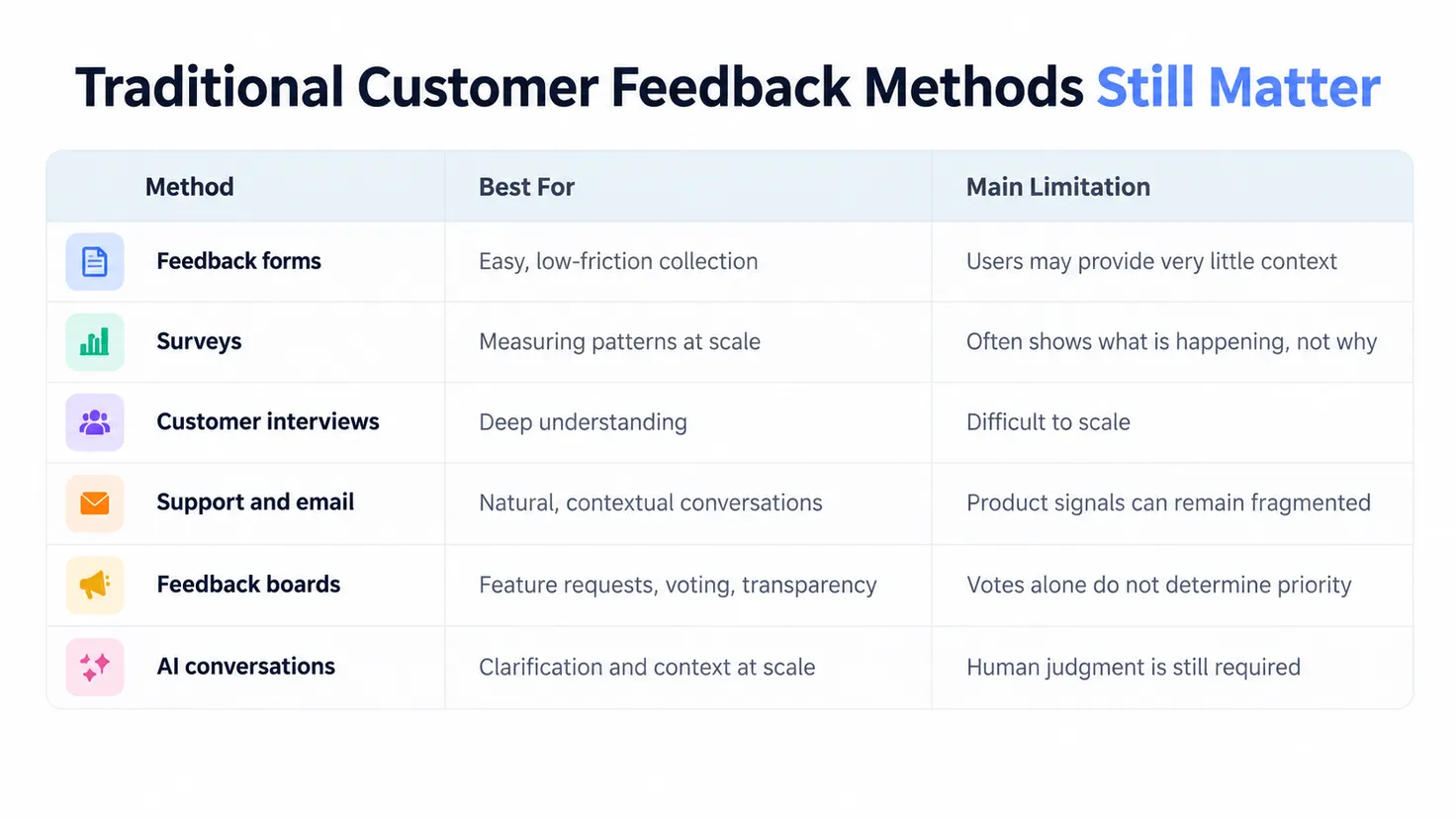
A survey, for example, might show that onboarding satisfaction dropped from 4.3 to 3.7 after a redesign. That is valuable because the team now knows something changed. But the number alone does not explain whether customers are confused by account setup, unable to import data, or simply unsure what to do after creating an account.
An interview can answer those questions because a researcher can respond to an unclear answer with another question. The problem is scale. A product manager may be able to conduct 10 or 20 useful interviews in a month, but cannot have the same conversation with thousands of users.
Feedback boards solve yet another problem. When customers can see existing requests and vote instead of creating a new post every time, duplicate feedback becomes easier to manage and demand becomes more visible. But votes still need interpretation. One hundred votes do not automatically mean that a feature belongs on the roadmap, just as ten votes do not automatically mean that a problem is unimportant.
The weakness is therefore not that traditional methods are ineffective. It is that each method captures a different piece of the customer experience. A good customer feedback system needs to connect those pieces instead of assuming that any single channel provides the complete answer.
What Changes When AI Is Added to Customer Feedback?
Traditional feedback usually follows a simple process:
Customer → Submit → Team receives → Team interprets
The problem is that customers do not always explain what they mean clearly. If someone writes, “Your pricing page is confusing,” the team still has to figure out whether the problem is pricing, plan differences, usage limits, or something else.
AI can move part of that work earlier by turning submission into a conversation:
Customer → Conversation → Clarification → Structured feedback → Team evaluates
For example:
Customer: Your pricing page is confusing.
AI: What part was difficult to understand?
Customer: I couldn't tell which plan includes team members.
AI: Are you comparing plans for yourself or a team?
Customer: For a 10-person team.
Instead of receiving a vague complaint, the product team now knows the actual context: a potential customer evaluating the product for a 10-person team cannot understand which plan supports team members.
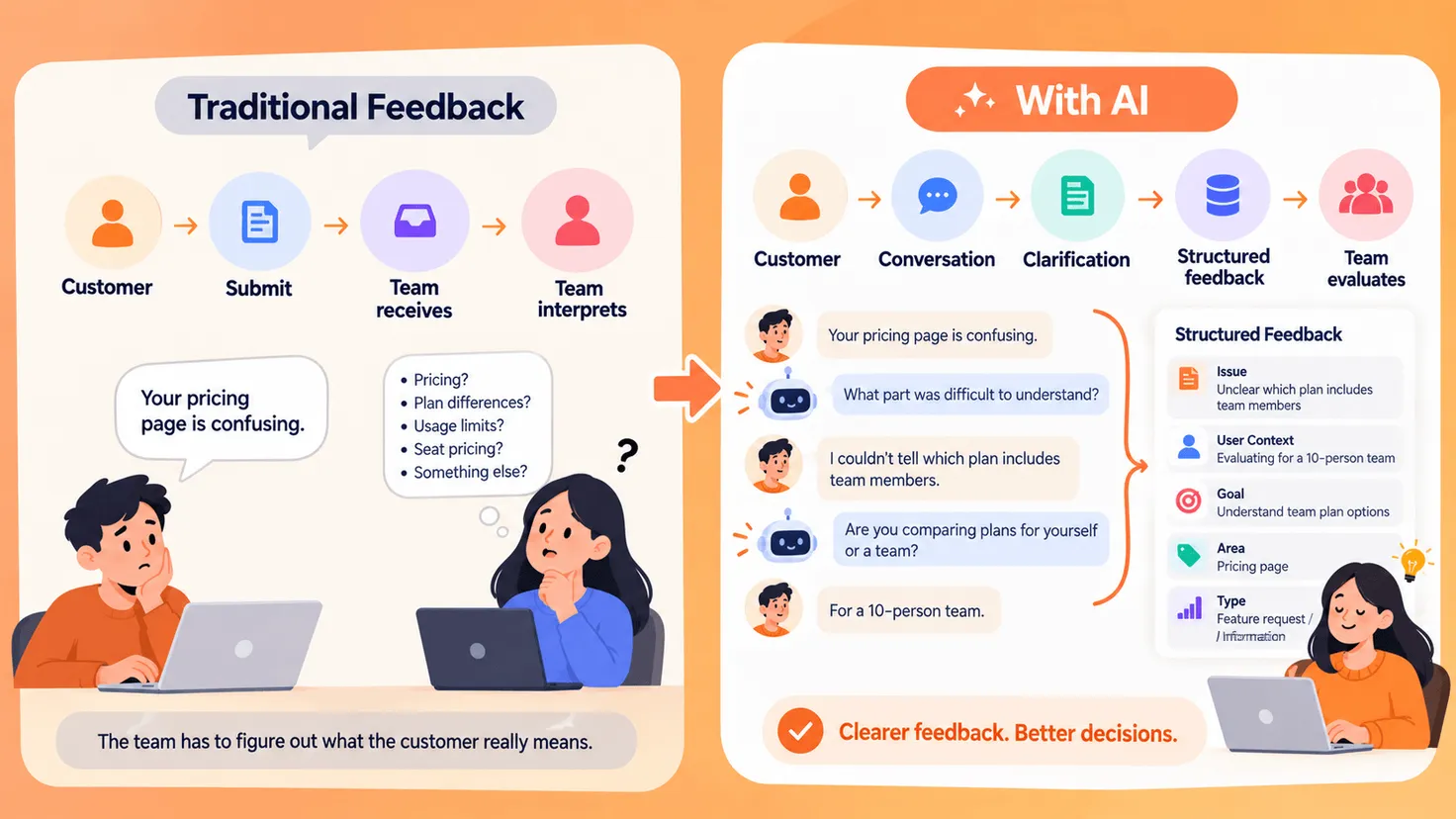
This is where AI adds value. It does not decide whether the pricing page should be redesigned or whether this issue should be prioritized. It simply turns vague feedback into clearer information before the product team makes a decision.
From Feedback Widget to Feedback Agent
The Feedback Widget already makes customer feedback easier to collect. Instead of searching for a feedback page or filling out a complicated form, users can describe a problem directly inside the product. FeedLog can understand that message, structure it, and turn it into feedback that can be managed on the feedback board. This shortens the path from user voice to product feedback and gives teams a faster way to capture real needs.
But as AI becomes more capable, simply collecting and structuring feedback is no longer enough. The next challenge is understanding the problem more accurately before it reaches the product team.
That is why FeedLog is evolving the Feedback Widget into a Feedback Agent. The Agent will go beyond the user's first message by retrieving relevant information from the product knowledge base and using that context to ask meaningful follow-up questions.
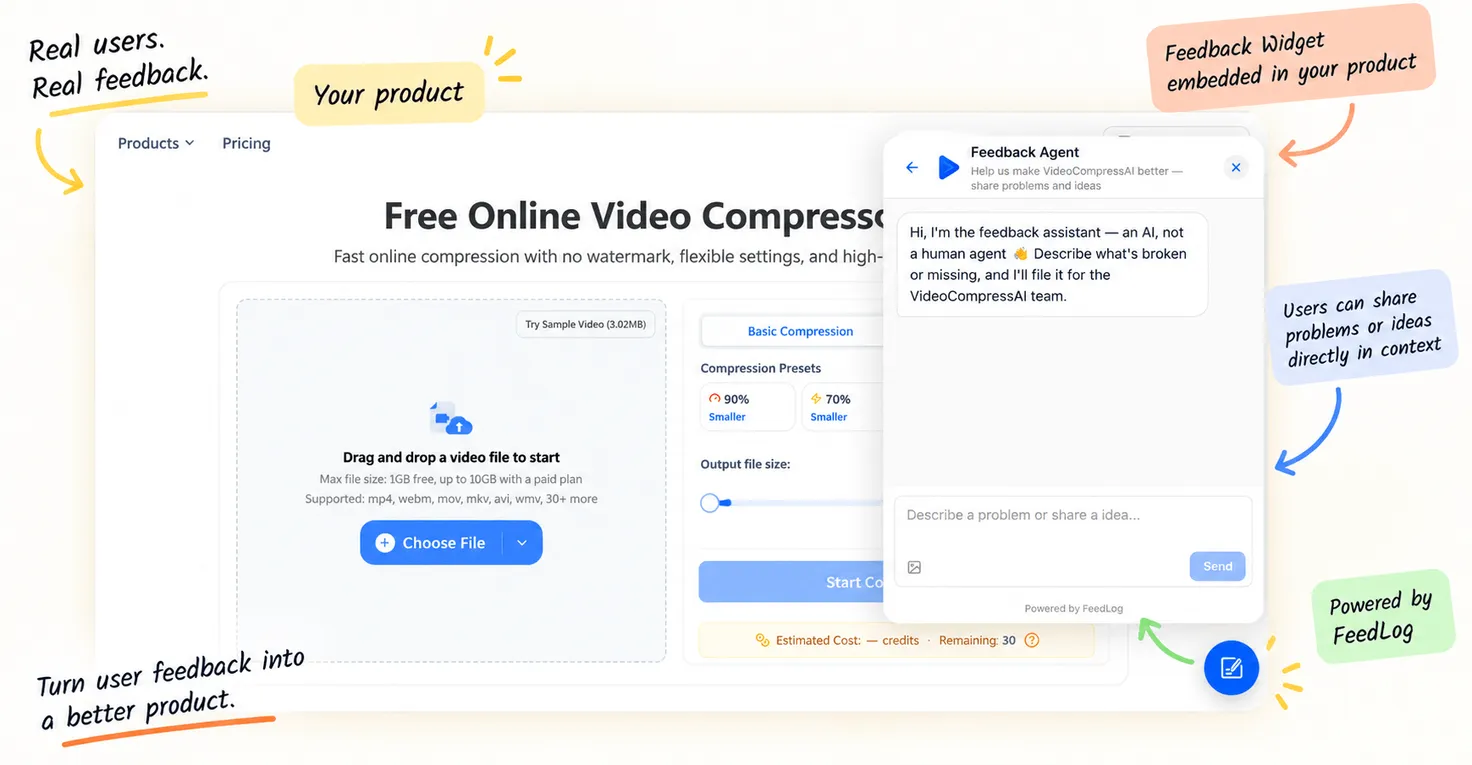
For example, when a user says, “I can't export my report,” the Agent can first check what export features already exist, then clarify whether the user cannot find the feature or actually needs a different export workflow.
The goal is not to create more conversations. It is to make each conversation more useful: use product knowledge to ask better questions, understand the real problem, and turn it into more accurate product feedback.
How AI Should Fit Into a Customer Feedback System
The move from a Feedback Widget to a Feedback Agent points to a broader principle: AI is most useful when it improves the information around a customer problem, not when it replaces the product decision that follows.
Before feedback is submitted, AI can help when the user's first message is incomplete. Instead of adding more required fields to a form, a Feedback Agent can retrieve relevant product knowledge and ask a targeted follow-up question. This helps clarify what the user is actually trying to accomplish while the context is still fresh. After submission, AI can connect similar requests, summarize longer conversations, and surface patterns that would be difficult to find manually.
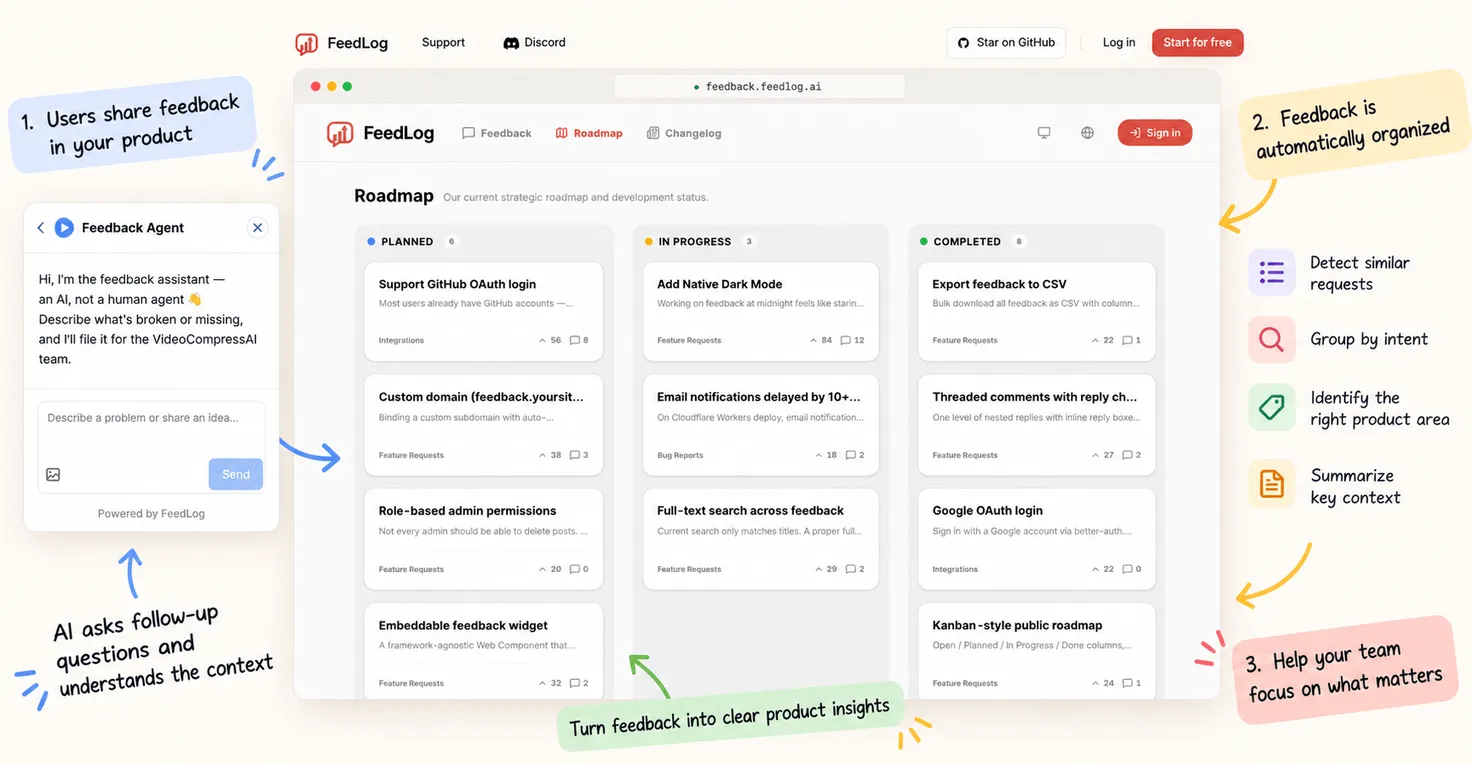
But the process should stop before understanding becomes decision-making. If 30 customers describe the same reporting problem, a Feedback Agent can help show what they have in common, which workflows are affected, and what the product already supports. It cannot determine on that evidence alone whether the team should build a new feature.
That decision also depends on product strategy, customer impact, technical cost, business priorities, and trade-offs with other work.
A useful division of responsibility is therefore:
A Feedback Agent retrieves, clarifies, connects, and structures. The product team prioritizes and decides.
Conclusion
A useful customer feedback system does more than collect requests. It helps teams move from what customers say to a clearer understanding of the problems behind those messages.
Traditional feedback tools have made collection, organization, and communication much easier. AI creates an opportunity to improve another part of the process: understanding. It can retrieve relevant product context, clarify incomplete feedback, connect related signals, and give product teams better information before they make a decision.
That does not mean AI should decide what gets built. Product strategy, priorities, and trade-offs still require human judgment. The value of AI is in making sure those decisions begin with a more accurate picture of the customer problem.
This is the direction we are exploring with FeedLog as we evolve from a Feedback Widget toward a Feedback Agent: not simply collecting more feedback, but helping teams understand what users actually mean before valuable context is lost.
Better product decisions start with better feedback, and better feedback starts with better understanding.