 Chloe HartLast Modified: Oct 28, 2026
Thank You for Your Patience: 12 Better Ways to Say It




“Thank you for your patience” is one of the most common phrases in customer support. It's polite, professional, and useful when someone has been waiting for a response or a solution.
But when customers have already waited hours or days, the same phrase can start to feel a little empty.
Sometimes, a more personal response works better:
- “We appreciate your patience while we work on a solution.”
- “Thanks for bearing with us. Here's where things stand.”
- “We know this is taking longer than expected, and we appreciate you sticking with us.”

The best wording depends on what happened, how long the customer has waited, and what you can actually tell them.
Below are 12 alternatives you can use right away, followed by customer support examples for common situations.
12 Better Ways to Say “Thank You for Your Patience”
There isn't one perfect replacement for “thank you for your patience.” A customer waiting for a routine reply needs a different tone from someone whose account has been inaccessible all morning.
Here are 12 alternatives, grouped by when they work best.
Professional Alternatives
These expressions work well in support emails, formal updates, and business communications.
1. We appreciate your patience while we look into this.
A safe choice when you're still investigating a problem. It acknowledges the wait without promising a specific outcome.
Example: “We appreciate your patience while we look into the issue with your subscription.”
2. Thank you for giving us time to resolve this.
Useful when your team needs additional time to investigate or fix something. It sounds more specific than a generic thank-you.
Example: “Thank you for giving us time to resolve the login issue. Our team is still investigating.”
3. We appreciate your understanding as we work on a solution.
This works when you've already explained the situation and the customer has been cooperative.
Be careful about assuming someone understands or accepts a delay, especially if they're frustrated.
4. Thank you for bearing with us.
A professional but slightly warmer alternative. It's especially useful when an issue has taken longer than expected.
Example: “Thank you for bearing with us while we restore access to your account.”

Friendly and Natural Alternatives
For live chat, smaller SaaS teams, and less formal conversations, these phrases can sound more human.
5. Thanks for sticking with us!
A friendly way to acknowledge someone who has continued working with your team through a frustrating issue.
6. Thanks for hanging in there.
Casual and reassuring, but not ideal for serious complaints or formal business emails.
7. We really appreciate you waiting.
Simple, direct, and less scripted than a formal corporate response.
8. Thanks for giving us a little more time.
Useful when you need a short extension and have already explained why.
Avoid using “a little more time” if you have no idea how long the issue will take.
Alternatives That Show Progress
When customers have been waiting for a fix or an update, the most helpful response usually includes new information.
9. We're still working on this, and we'll share an update as soon as we have one.
Use this when the issue remains unresolved. If possible, include when the customer should expect the next update.
10. We've identified the issue and are working on a fix.
This gives customers something more useful than a generic apology. Only use it when the problem has actually been identified.
11. Your request is still under review, and we'll keep you posted.
A good choice for feature requests or account-related issues that require additional review.
12. Thanks for waiting. Here's what we've found so far.
One of the strongest alternatives when you have meaningful progress to share.
Instead of simply acknowledging the delay, you're giving the customer a reason to feel that their issue is moving forward.
The wording matters, but a complete response often matters more. A customer doesn't just want to hear that you appreciate their patience. They want to know what happens next.
For SaaS teams handling these conversations every day, tools like FeedLog help make customer support more efficient. Its AI agent answers common questions using your knowledge base, while more complex issues can be handed over to your team—all without making customers leave your product.
“Thank You for Your Patience” Examples for Customer Support
A thoughtful reply can make customers feel heard, but what they really want is a clear answer. A well-maintained knowledge base helps customers find answers to common questions without waiting, while AI support can make that information easier to access.
For issues that need more attention, the right response still matters. Here are five common SaaS customer support scenarios, with practical examples you can adapt to keep customers informed.
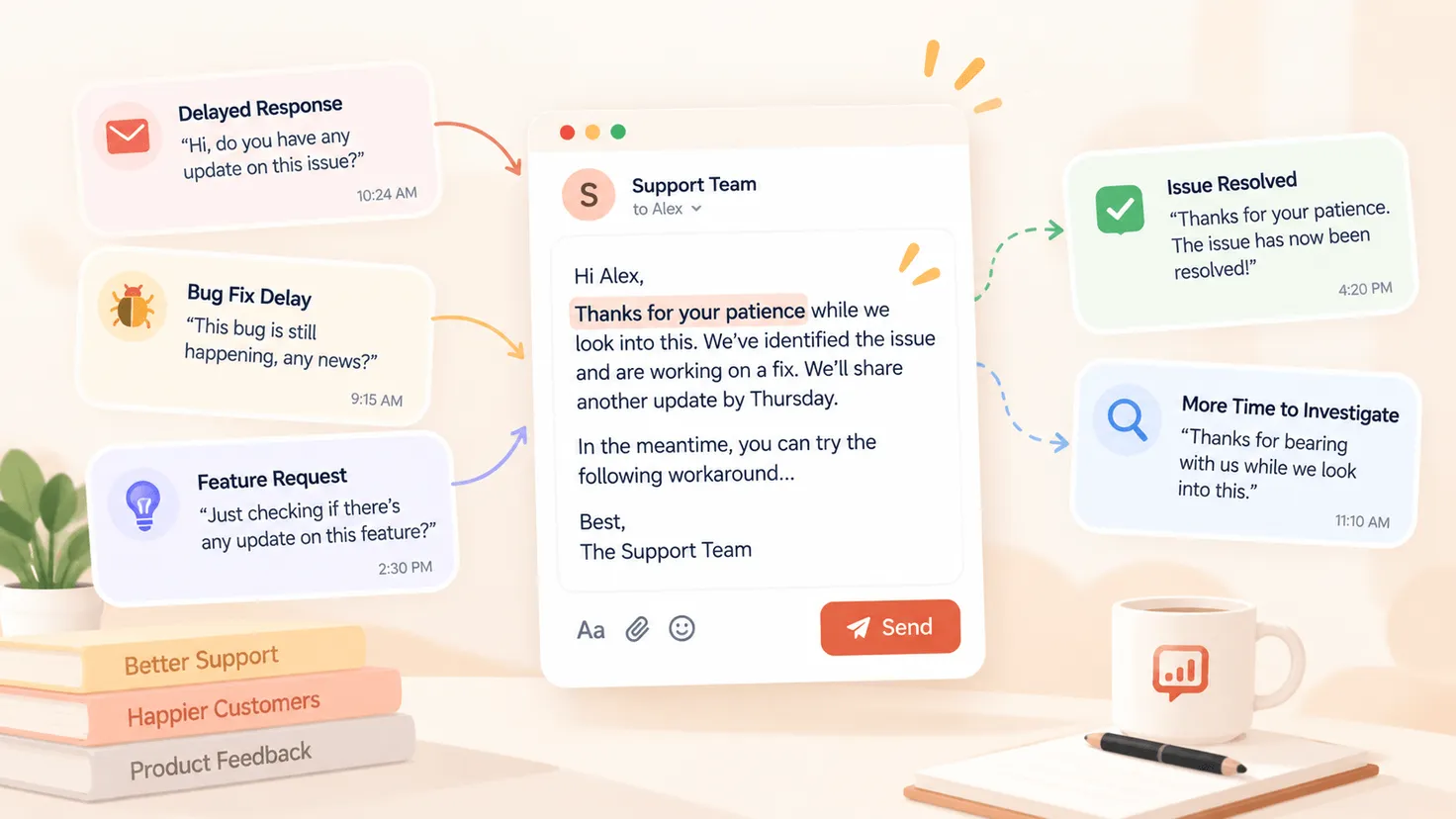
1. When a Customer Is Waiting for a Reply
Example:
Hi [Name],
Thanks for your patience, and sorry for the delay in getting back to you.
We've reviewed your question about [topic]. Here's what we found: [brief explanation].
If you still need help, just reply here and we'll take another look.
Best,
[Team Name]
Why it works: It acknowledges the delay, answers the original question, and makes it easy for the customer to continue the conversation.
Avoid thanking someone for waiting if you haven't actually addressed what they contacted you about.
2. When a Bug Is Taking Longer to Fix
A bug that interrupts someone's workflow can be especially frustrating. Customers need to know that the issue is understood, not just that someone is sorry.
Example:
Hi [Name],
We know this bug has been slowing you down, and we appreciate your patience.
Our team has reproduced the issue with [feature] and is working on a fix. We don't have a confirmed release date yet, but we'll update you by [date].
In the meantime, you can try [workaround], if that works for your situation.
Thanks again for reporting this.
Why it works: The reply shares what the team knows, avoids an unrealistic deadline, and offers a next step.
If the issue hasn't been reproduced, say that instead. Asking what the customer was doing immediately before the error occurred may be more helpful than requesting a vague description of the problem.
A useful customer feedback process should preserve that context so the team doesn't have to ask the same questions repeatedly.
3. When a Feature Request Is Still Under Review
Feature requests are different from bugs. The customer may be asking for something your product doesn't currently support, and you may not know whether or when it will be built.
Example:
Hi [Name],
Thanks for sharing this idea with us!
We can see how [requested feature] would help with [customer's use case].
We've added your request to our feedback board so the team can review it alongside similar suggestions. There's no confirmed timeline yet, but we'll share updates if its status changes.
We appreciate you taking the time to explain what you're trying to accomplish.
Why it works: It acknowledges the customer's actual use case without making promises the team can't keep.
If a feature request is only being considered, avoid saying “it's coming soon.” That can create expectations your team may not be able to meet.
4. When a Service Issue Has Been Resolved
Once the issue is fixed, customers shouldn't have to guess whether everything is working again.
Example:
Hi [Name],
Thank you for your patience while we worked through the service interruption.
The issue affecting [service or feature] has now been resolved, and we've confirmed that the service is operating normally.
You should be able to [affected action] again. If you're still experiencing problems, please let us know.
We're sorry for the disruption and appreciate you sticking with us.
Why it works: It confirms the outcome and tells customers what they can do next.
Only describe an issue as resolved once your team has verified the fix.
5. When You Need More Time to Investigate
Sometimes, the most useful thing you can do is be clear about what you don't know yet.
Example:
Hi [Name],
Thanks for bearing with us.
We're still investigating [issue], and we want to make sure we give you an accurate answer rather than guess.
Could you share [specific information needed]? That will help us narrow down what's happening.
We'll follow up by [date], even if we're still working on the investigation.
Thanks again for your help.
Why it works: It explains why more time is needed and gives the customer a specific action.
For support teams handling repeated issues, capturing these details in the original conversation can also make future investigations easier.
These examples all have something in common: they go beyond polite wording. They acknowledge the situation, share what is known, and explain the next step.
But should you thank a customer for waiting, or apologize for making them wait?
“Thank You for Your Patience” vs. “Sorry for the Inconvenience”
Both phrases are common in customer service, but they communicate different things.
“Thank you for your patience” focuses on the customer's cooperation or willingness to wait.
“Sorry for the inconvenience” acknowledges that something has gone wrong and may have caused frustration.
| Situation | Better Approach |
|---|---|
| A customer is waiting for a routine update | Thank them for their patience |
| Your service outage disrupted their work | Apologize for the disruption |
| A bug is taking longer than expected | Acknowledge the problem and thank them for waiting |
| A customer has made a serious complaint | Start with a sincere apology |
| An issue has been fixed after a delay | Confirm the fix, apologize if appropriate, and thank them |
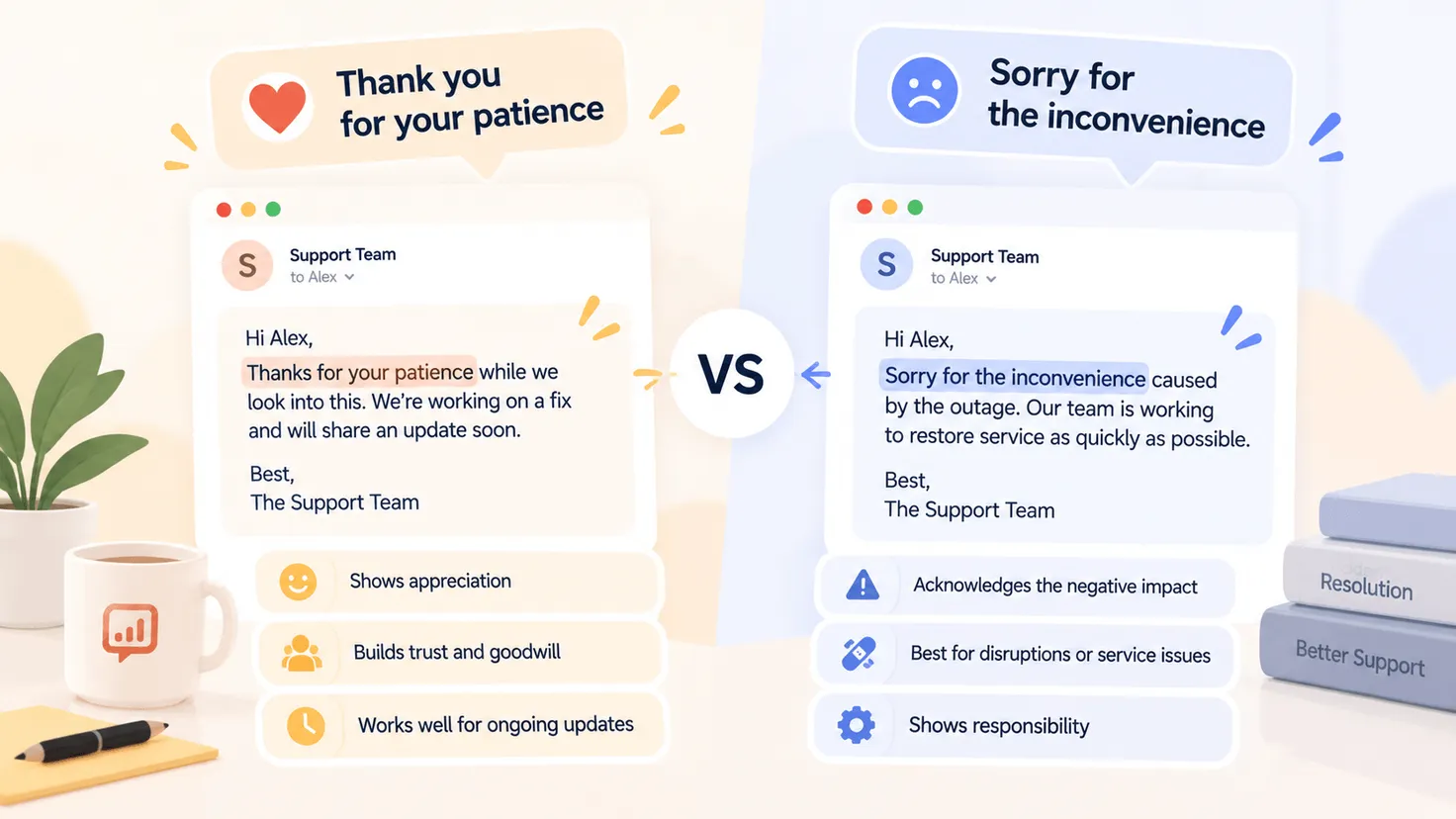
For example, imagine a customer couldn't access their dashboard for several hours.
A reply that only says:
“Thank you for your patience.”
might feel dismissive.
A more useful response would be:
“We're sorry the dashboard outage interrupted your work. Access has now been restored, and we appreciate your patience while our team resolved the issue.”
This acknowledges the impact, confirms the result, and expresses appreciation.
You don't always have to choose one phrase over the other. In some situations, an apology and a thank-you work best together.
The important thing is to avoid using either expression as a substitute for a meaningful update.
Why “Thank You for Your Patience” Isn't Always Enough
Imagine reporting a bug that prevents you from completing an important task.
The first support reply says:
“Thank you for your patience. We're looking into it.”
Two days later, you receive almost the same message.
A week later, another reply arrives:
“We appreciate your continued patience.”
The messages are polite. But as the customer, you still don't know whether the issue has been reproduced, whether someone is working on it, or when you'll hear back.
That's where generic support responses start to lose their value.
The problem isn't necessarily the wording. It's the lack of useful information.
Customers generally want three things when an issue remains unresolved: confirmation that the problem is understood, a realistic explanation of its current status, and some idea of what happens next.
That doesn't mean support teams need to promise a fix date for every bug. Sometimes an honest “we're still investigating” is the right answer.
But even that response is more helpful when paired with a specific next step.
For small SaaS teams, keeping track of these conversations can become difficult. Questions arrive through different channels, bug reports get buried in chat histories, and feature requests are easy to forget once the conversation ends.
At that point, writing better replies is only part of the solution.
How to Keep Customers Updated Without Repeating the Same Message
A good customer support experience doesn't end when someone receives an answer. It ends when their issue is resolved, or when they know what will happen next.
For SaaS teams, that usually means connecting three parts of the process.
First, customers should be able to get answers to common questions without waiting for a team member. A knowledge-based AI assistant can help with questions about features, settings, and documented workflows.
Second, more complicated problems need a way to reach a real person. When an AI assistant can't resolve something, the conversation shouldn't disappear or force the customer to explain everything again.
Third, bug reports and feature requests need somewhere to go after the initial conversation. A support reply may acknowledge the issue, but the product team still needs to review it, prioritize it, and communicate progress.
This is the approach behind FeedLog, an open-source AI customer support and feedback platform built for SaaS teams.
FeedLog combines an in-product support widget with an AI agent that uses the team's knowledge base to answer questions. Unresolved conversations can move to Inbox for human follow-up, while product suggestions and bug reports can become structured feedback that teams manage through a feedback board, roadmap, and changelog.
For teams comparing support tools, our guide to AI chatbots for SaaS explores different approaches to customer support automation.
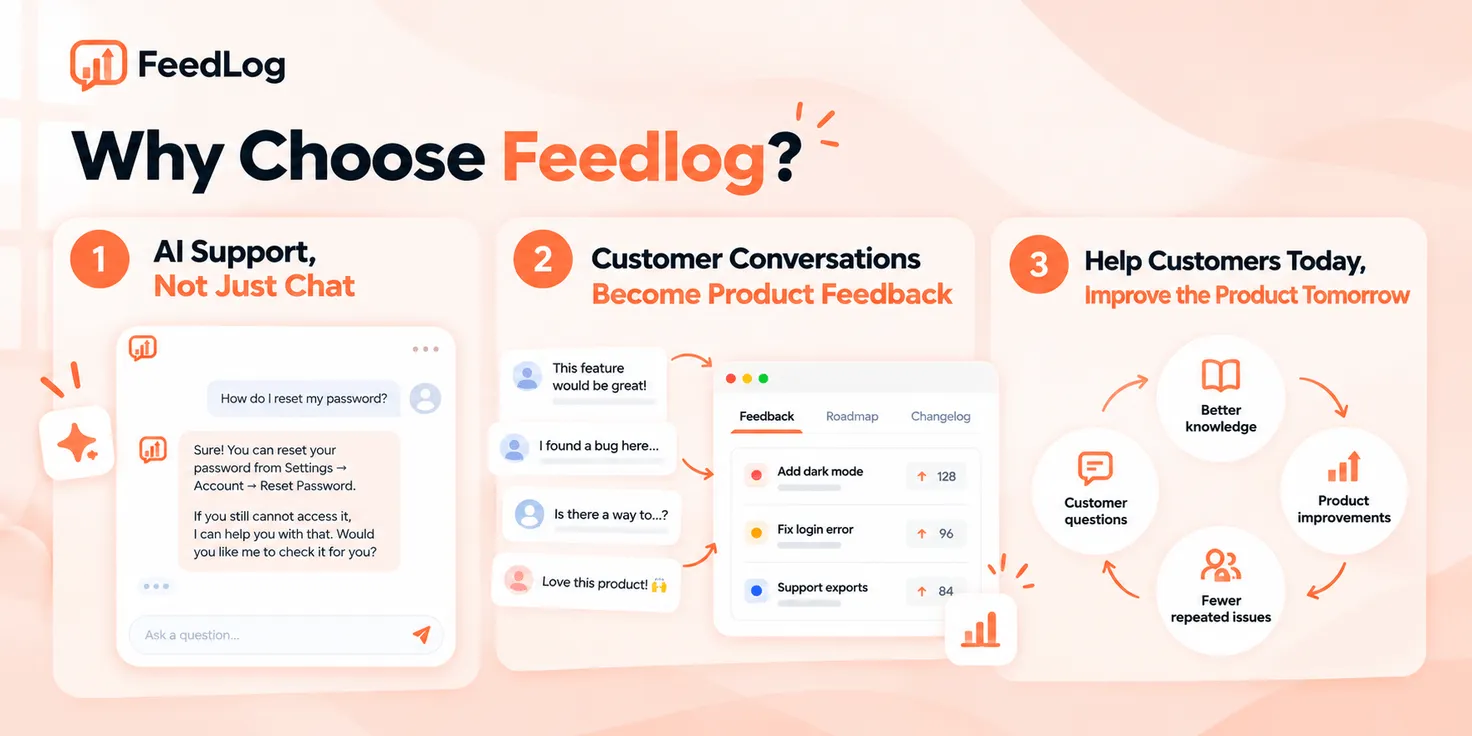
The goal isn't to eliminate polite phrases like “thank you for your patience.” It's to make those phrases part of a support experience where customers can actually see progress.
Conclusion
“Thank you for your patience” is a useful phrase, but the best customer support replies do more than sound polite.
They acknowledge what happened, share what the team knows, and give customers a clear next step.
Whether you're responding to a delayed email, an unresolved bug, or a feature request, choose words that fit the situation rather than relying on the same template every time.
And when your team finds itself repeatedly asking customers to wait, it may be time to improve the process behind those replies—not just the wording.
Frequently Asked Questions
Is “Thank You for Your Patience” Professional?
Yes. “Thank you for your patience” is a professional and widely accepted expression in business emails and customer service.
It's especially appropriate when someone has waited for a response, investigation, or resolution. For more serious problems, consider adding an apology and a clear update rather than relying on the phrase alone.
Is “Thanks for Your Patience” Polite?
Yes. “Thanks for your patience” is polite and grammatically correct.
It's slightly more casual than “thank you for your patience,” making it a natural choice for live chat, friendly emails, and everyday customer support conversations.
What Is a Better Way to Say “Thank You for Your Patience” in an Email?
A professional alternative is:
“We appreciate your patience while we work to resolve this issue.”
If you have an update, an even better option is:
“Thank you for bearing with us. We've identified the issue and are working on a fix.”
Choose wording that reflects the actual status of the problem.
Can You Say “Thank You for Your Patience” Before Someone Has Waited?
You can, but it may sound presumptuous if the person hasn't agreed to wait.
When requesting additional time, it's often better to explain what you need and ask politely.
For example:
“We need another day to investigate this. Would that be okay? We'll update you tomorrow.”
Is It Better to Say “Sorry for the Inconvenience” or “Thank You for Your Patience”?
It depends on the situation.
Use an apology when your company has caused a problem or disruption. Thank the customer for their patience when they've waited or cooperated during the resolution process.
For significant service issues, combining both expressions is often appropriate.